
To use AI for customer service without sounding like a robot, train it on your real business, keep replies short and specific, write in your own tone of voice and hand the conversation to a person as soon as it needs judgement or empathy. Customers don't mind talking to AI; they mind vague, repetitive answers and being trapped in a loop.
Why AI customer service sounds robotic
- It's generic. It doesn't know your services, prices or policies, so it hedges.
- It's too long. Five paragraphs to answer a yes/no question.
- It ignores context. It asks for details the customer already gave.
- There's no way out. Customers can't reach a person when they need one.
Eight rules for human-sounding AI
- Train it on your business — services, areas, pricing guidance, policies and your top 30 questions.
- Write a tone guide — "friendly, direct, Australian, no jargon, no exclamation marks overload".
- Keep answers to two or three sentences, then ask one question to move forward.
- Use what the customer said — their name, suburb and the service they asked about.
- Never guess on prices, policies, medical or legal topics; say you'll check and escalate.
- Offer a person whenever someone asks, is upset or has a complex request.
- Be transparent — introduce the assistant as your virtual assistant.
- Review weekly and add missing answers to the knowledge base.
Robotic vs human: the same enquiry, two replies
| Robotic | Human-sounding |
|---|---|
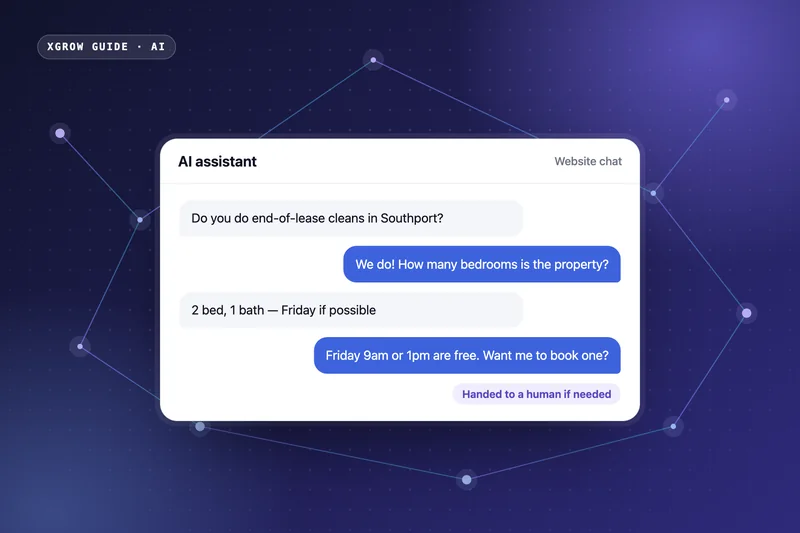
| "Thank you for contacting us. Your enquiry is important to us. Please provide your full name, address, phone number and a detailed description of your requirements and a team member will be in touch within 2–3 business days." | "Hi Sam! Yes, we do end-of-lease cleans in Southport. For a 2-bedroom unit we can do Friday 9am or 1pm — want me to lock one in?" |
The second reply is shorter, answers the question, uses the customer's details and moves straight to the next step. That's what good AI customer service looks like.
When AI should hand over to a person
- The customer asks for a human, or repeats themselves.
- There's a complaint, refund request or anything emotional.
- The request is high-value or needs a custom quote.
- The AI isn't confident in its answer.
The handover should include the full conversation so the customer never has to repeat themselves.
Keep it safe and compliant
Limit what data the AI can access, avoid collecting sensitive information in chat, and handle personal information in line with the Australian Privacy Principles. For businesses in health, finance or legal services, keep the AI to logistics — bookings, hours, directions — and leave advice to qualified people.
How to measure AI customer service quality
- First-response time and resolution rate.
- Handover rate — too high means gaps in knowledge; too low may mean customers are stuck.
- Bookings and leads created by the AI.
- Customer feedback and review sentiment.
XGROW builds AI chatbots and AI receptionists trained on your business with these rules built in.
Frequently asked questions
Should I tell customers they're talking to AI?
Yes. Being transparent builds trust, and customers mainly care about getting a fast, accurate answer with the option to reach a person.
Can AI handle complaints?
AI can acknowledge a complaint and collect details, but complaints should be handed to a person quickly — with the full conversation attached.
How long does it take to train an AI assistant?
A solid first version can be built from your FAQs and past conversations within a couple of weeks, then improved weekly as new questions appear.

Matheus Bessa is the founder of XGROW. He spent six years in marketing at Unilever Brazil and now builds CRM, marketing automation and AI systems for Australian service businesses. More about Matheus · LinkedIn