
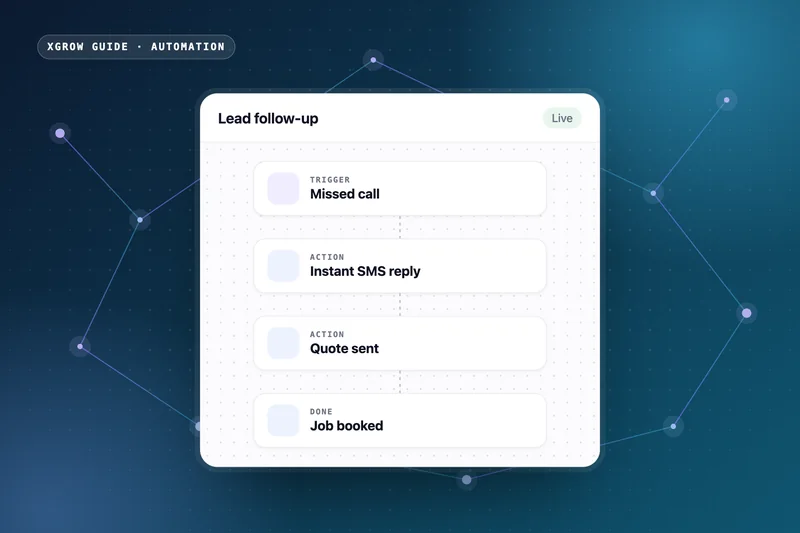
To stop losing leads when you're busy, automate the first response. Every missed call should get an instant text, every form and message an immediate personal reply, and every quote a scheduled follow-up — so no lead waits for you to be free. Then use AI to qualify and book the ready leads, and nurture the rest until they are.
Why speed-to-lead matters
People who enquire are usually contacting several businesses at once. The first helpful reply tends to win. A Harvard Business Review study of online sales leads found that companies that responded within an hour were nearly seven times as likely to qualify the lead as those that responded even an hour later — and that many companies took far longer. For a small business, the gap between a two-minute and a two-day reply is often the gap between winning and losing the job.
The five places small businesses lose leads
- Missed calls that go to voicemail while you're on a job or after hours.
- Website forms that land in an inbox nobody checks until the evening.
- Social DMs on Instagram and Facebook that sit unread for days.
- Quotes that are sent and never followed up.
- "Not yet" leads who were interested but not ready, and never heard from you again.
The 5-minute follow-up system
| Step | What happens | Tool |
|---|---|---|
| 1. Capture | Every call, form, DM and email lands in one pipeline | CRM |
| 2. Instant reply | Missed-call text-back and a personal auto-reply within seconds | SMS / chat automation |
| 3. Qualify | A couple of questions: what, where, when | AI assistant |
| 4. Book | A link or live booking into your calendar | Online booking |
| 5. Follow up | Scheduled nudges until they reply, book or opt out | Nurture sequence |
The system stops automatically as soon as a person replies, so customers never get a robotic message after a real conversation has started.
What AI adds to lead follow-up
Rules-based automation handles the basics. AI makes the follow-up feel personal and useful:
- Understands free-text replies ("can you come Thursday arvo?") and responds sensibly.
- Answers questions about your services and areas using your own information.
- Scores leads by intent so your team calls the hottest ones first.
- Works 24/7, across SMS, WhatsApp, Instagram, Messenger and web chat.
For calls, an AI receptionist can answer and book live. For messages, an AI chatbot does the same in writing. Both feed the same CRM.
Metrics to track
| Metric | Why it matters |
|---|---|
| Median first-response time | The single biggest driver of conversion |
| Contact rate | Share of leads you actually spoke or messaged with |
| Booking rate | Share of leads that became a quote or appointment |
| Win rate by source | Which marketing produces customers, not just leads |
One client, Oven Brothers, was running bookings, payments, email marketing and CRM in four disconnected systems and losing leads nobody had time to follow up. After moving everything into one system they report a 300% increase in organic revenue. You can read their review on our reviews page.
Where to start this week
- Switch on missed-call text-back.
- Route every enquiry source into one inbox or CRM.
- Write a friendly instant reply for forms and DMs.
- Add a two-step quote follow-up.
Or let XGROW set up AI lead nurturing for you — start with the free strategy call.
Frequently asked questions
How quickly should I respond to a new lead?
As fast as possible — ideally within minutes. Research published in the Harvard Business Review found that responding within an hour made firms nearly seven times more likely to qualify a lead than responding later.
What is missed-call text-back?
An automation that sends an instant SMS to anyone whose call you miss, so the conversation continues by text instead of the caller trying a competitor.
Won't automated replies feel impersonal?
Not if they are short, specific and written in your voice — and if a person takes over as soon as the customer replies. Customers mostly notice that you responded quickly.

Matheus Bessa is the founder of XGROW. He spent six years in marketing at Unilever Brazil and now builds CRM, marketing automation and AI systems for Australian service businesses. More about Matheus · LinkedIn